
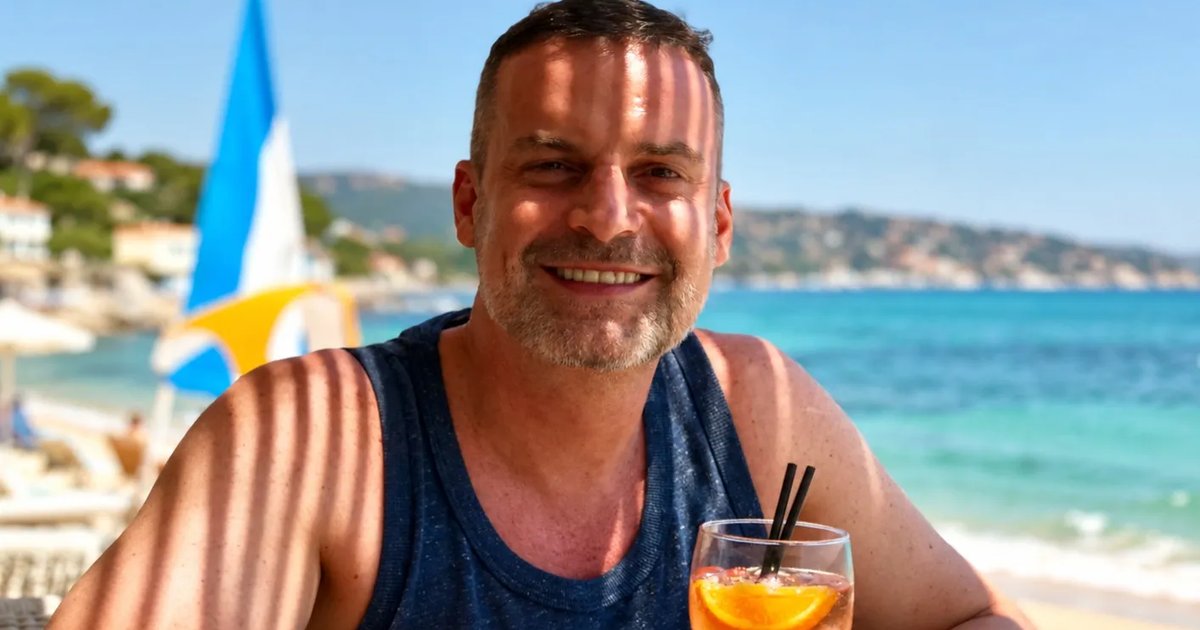
The origins: the gay retirement village I couldn't build on my own
A little over ten years ago, as I got closer to fifty, I started asking myself a question that I suspect a lot of us ask: how do I grow older without having to hide who I am? I'd watched my grandparents spend their last years in a retirement home, and I couldn't picture myself somewhere like that, going quiet about my life to fit in. I've always liked people and their company. So I started planning a gay retirement village instead.
It doesn't exist yet. This is the story of why, and of what I built while I keep looking for the land.
Tables for eight
I'm French, and for people my age Club Med is part of growing up. It's what you dreamed of for a holiday once you were old enough to choose your own. But I only really understood what it does when I started the European Gay Ski Week in 1996, with around 600 gay men in one resort.
At breakfast the tables were for eight. Whether you'd come with a partner or on your own, you ended up eating with people you'd never have spoken to otherwise. If you got on, you had lunch together. If you didn't, you moved on and tried another table. Ski classes mixed people up the same way, and after a few days you started noticing things about people you'd missed on the first day. Real friendships came out of it.
That's what I wanted to grow old in. A permanent version of that week: a restaurant you can join when you don't feel like cooking, sport and classes if you want them, and people around you every day.
The first plan: a small retirement home
My first plan was modest: a small gay retirement home with five or six rooms. I sent it to my close friends as a kind of group letter. The replies were warm. Everyone thought it was a beautiful idea, and several pointed out that a lot of men who'd come through the AIDS years were reaching exactly the age to think about this.
Then almost every one of them, all around my age, said the same thing: "Yeah, but it's not quite for me just yet." Nobody could picture themselves living there on the day they read it. Others pointed out that five or six rooms would never pay for the staff and the shifts a place like that needs. And it was clear that selling what I owned wouldn't come close to funding it. I'd need investors.
The second plan: The One Gay Resort
So in 2019 I started on something bigger, and in January 2020 I wrote to the same friends again with the reworked plan. I called it The One Gay Resort: a gay social club near Sitges, somewhere between Club Med and Soho House. Twenty rooms you could take by the day or the month, like a pied-a-terre near the beach. Tennis, a pool, a few petanque lanes, a gym and a spa, a co-working space, and a shuttle every hour from Sitges station. Classes every week, from yoga and tai chi to choir and flamenco. Members from 25 to 70, with no ageism allowed.
And all summer, Social Sundays: a barbecue, cocktails, guest DJs and drag queen bingo, free for members and open to anyone else for a fee. Dublin has its Social Sundays at the George and London has Sunday afternoons at the Royal Vauxhall Tavern. Sitges had nothing like it.
In that version, nobody lived there permanently. As I wrote at the time, I'd moved from "a gay retirement home project that everyone seemed to like but where no-one related" to something more exciting, for people of all ages. I still love that plan. But the land and the building costs were, in my own words then, "far above my humble abilities."
Today's plan, with my feet back on the ground
Since then I've come back down to earth. Today's plan keeps the best of both: a place to live, with the club life built in, grown in four phases on one piece of land.

Phase one: a pool, the restaurant and a few small houses or tiny homes scattered around.
Phase two, once those are lived in: more homes, plus daily classes and courses. If we're close enough to somewhere like Sitges, this is when the Social Sundays come back, with the doors open to people from outside who pay as they come in. A Sunday barbecue, a karaoke night, an evening somebody takes the trouble to organize.
Phase three: homes for guests, people coming for a day, a week or a month. It's the part I still like most. Living in a community can mean the same twenty or thirty faces forever, and a steady flow of new people keeps it alive.
Phase four: for later, when some of us can't manage on our own any more, a more assisted kind of living, on the same land, among the same people.
The land problem
Even then, the last question in my letter was about land: how hard would it be to find the right piece, and how fast would I have to jump on a listing on Idealista when it came up? My first wish is still somewhere near Sitges, but Catalonia is expensive, and by the sea near Sitges it's out of reach. So I've looked further south, where land costs much less.
That's where I hit the real wall. In Spain, what you can build on a piece of land is decided region by region and town by town, so it varies. But Instagram is full of tiny houses and capsule homes, and in everything I looked at, I never found land where I'd have been allowed to put them.
I looked at campsites too. Spain doesn't let you make a campsite your permanent home. Each region sets its own limits, usually six or seven months a year, and eleven in Aragon (Merca2, 2023). France does allow it, under conditions: the campsite has to be open all year and the mobile home has to be fixed in place (Matmut). I haven't taken that route further yet, but it's still on my list.
Nowhere to find each other
So I went looking for other gay men who wanted the same thing. They were out there, but spread across Facebook groups all over the world, and a search on Reddit or Google never got me anywhere near putting a project together. There was no place built for it.
That's why I started Among Our People. Community Living came first: somewhere to post a project like mine, find one that's already forming, or use the notice board to ask the questions I couldn't get answered anywhere else.
While I was researching, I kept finding other gaps with the same root. People looking for a flatmate who wouldn't make them explain themselves. People who'd moved to a new city and had no one to have a coffee with. People who wanted a plumber or a therapist from their own community. Different needs, but underneath all of them was the thing I was trying to fix for myself: loneliness and isolation. So those became part of the site too, in Find a Gay Flatmate, Find a Local Gay Friend and the LGBTQ+ professionals directory.
You don't have to move in to help
A project like this needs more than future residents. It needs a landowner, a builder, a solicitor who knows the planning rules, maybe a yoga teacher or a tiny-home maker, maybe a company that builds housing for older people and wants to test the water. On Among Our People, people who want to live in a project ask to join it, and people who want to help tag themselves to it and say what they can offer. Both can follow and shape it from there.
The notice board comes before all of that. I'd love to see the mayor of a small town in the middle of Spain or Italy post there: "We need more people living here. Would a project like this work for us?" That's exactly the kind of question that gets a project started.
Where my project stands
Ten years on, I still want to live in it, and to sit on the committee that decides who comes, what we build and how we grow. Nothing is bought yet, and I'm still looking for the right land and the right way to do it. I'd like us to be living there within eight years.
The core of the group will be gay men from fifty onwards, because that's the life I'm picturing for myself. Lesbians and trans people are welcome from the start, and in the later phases I'd like it to open up further, including to older people who need care, if we can look after them properly.
If you can picture yourself at that table for eight, or you can help build it, my project is here. And if you've got a project of your own in mind, start with the notice board. It's how mine should have started. ✦
Eric Crespin, founder of Among Our People