
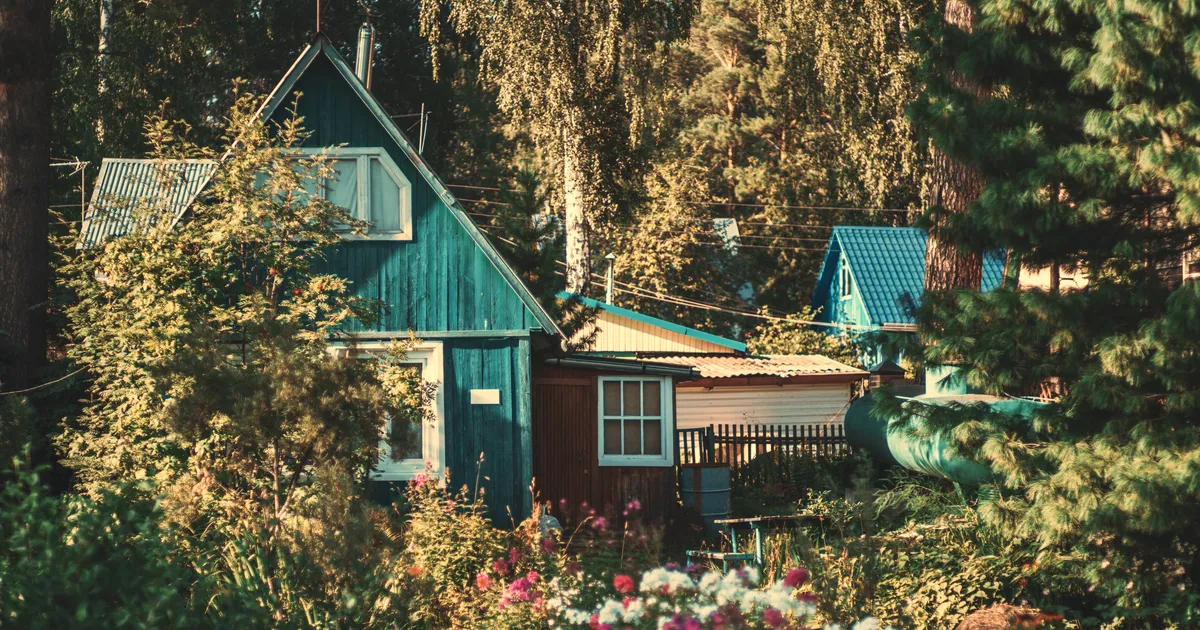
Tiny house communities for seniors: what exists, and the land problem nobody mentions
Tiny house communities for seniors do exist, but there aren't many, and most are small places started by one determined person or a charity. The house itself is rarely the hard part. Finding land where you're allowed to live in one all year is.
This guide covers the villages open today in the US, the planning hurdles in the US and Spain, and how a group of LGBTQ+ friends could start one of their own.
What a tiny house community actually is
Picture a handful of very small homes, usually under 400 square feet, on one shared piece of land. Each person has their own front door and their own kitchen. Then there's something shared, often a garden and sometimes a common room where people eat together once a week.
Some sit on foundations; others are built on wheels. That difference sounds technical, but it decides almost everything about where you can live, as you'll see below.
The Bird's Nest, Cumby, Texas
Robyn Yerian bought five acres about an hour from Dallas in 2022, using her own retirement savings. She was 70 when Good Good Good wrote about her in August 2025. It's for women only. There are 14 concrete pads with hookups, and residents bring or build their own tiny home. In 2024 the pad rent was $450 a month, covering water, septic, trash and lawn care, and she had promised not to raise it above that (Tiny House Talk, June 2024). "We are each other's therapists and sounding board," she told Good Good Good.
Trinity Village, Pensacola, Florida
The Catholic Diocese of Pensacola-Tallahassee built this one in downtown Pensacola, and Fox10 reported on May 1, 2026 that it "has officially opened." It has nine homes, for seniors on fixed incomes who are struggling with rising rents. Each home is just under 300 square feet with ten-foot ceilings, and they were paid for with donated money. In November 2025, WUWF reported that rent would be about $500 a month, utilities included. Fox10 points readers to the diocese's page, ptdiocese.org/trinity-house, for details.
Village Hearth, Durham, North Carolina
Village Hearth is co-housing, not a tiny house village. It's a 55+ community of 28 homes on 15 acres, created by and for LGBTQ+ people and their allies, and residents have lived there since 2020. Each household owns its home, and the residents run the shared parts together. We've included it because it's the closest thing we know of to what many LGBTQ+ readers are picturing.
These three work in different ways: the Bird's Nest is a lot-rent community, Trinity Village is affordable housing run by a church, and Village Hearth is co-housing.
| Place | Where | What it is | Who it's for | What it costs |
|---|---|---|---|---|
| The Bird's Nest | Cumby, Texas | Lot-rent community, 14 pads, since 2022 | Women | $450 a month pad rent (2024 figure), you bring the home |
| Trinity Village | Pensacola, Florida | Affordable rentals, 9 homes, open since 2026 | Seniors on fixed incomes struggling with rent | About $500 a month, utilities included (WUWF, Nov 2025) |
| Village Hearth | Durham, North Carolina | Co-housing, 28 homes, lived in since 2020 | 55+, LGBTQ+ people and allies | Homes are bought, not rented |
Is there one for LGBTQ+ people?
Not that we could find, at least not one that's open. SAGE, the US charity for LGBTQ+ elders, lists tiny homes alongside mobile homes and RVs as a cheaper option with "the potential for intentional community living", but it doesn't point to a village. That's the gap. And it's exactly the kind of project Among Our People was built for: Eric Crespin, who founded the site, has spent ten years trying to start a gay retirement village built around small homes, and you can read how that started.
The planning hurdles in the US
Since 2018, the International Residential Code, the model building code used across the US, has had a section just for tiny houses. It was Appendix Q in the 2018 edition and is Appendix AQ in the 2021 edition. It covers homes of up to 400 square feet and relaxes things like ceiling heights, lofts and stairs so a small house can still pass inspection.
There are two catches. First, it only applies where your state, county or city has adopted it, and not all of them have. Second, it's written for homes on a foundation. A tiny house on wheels is usually treated as a recreational vehicle, and the International Code Council is blunt about that: "RVs are intended for seasonal or intermittent use, not as permanent residences." Whether you can live in one full time comes down to your county's rules.
So before anyone buys land, ask the county planning office two questions. Can a house this size be a permanent home on this plot? And can several of them share it?
The planning hurdles in Spain
Read this as a starting point for your own local checks, not as a summary of national law. In Spain, what you can put on a piece of land is decided by the region and the town hall, so the answer can change from one town to the next.
As a general guide, idealista (November 2025) says a mobile home or tiny house you live in is treated as a home, so in a town it has to meet the same requirements as an ordinary house. On rural land (suelo rústico) it generally can't go at all, apart from a few exceptions. idealista's own advice is to check the rules of the town where you want to put it.
One court case shows how badly it can go. In a case reported in October 2025, the provincial court in Córdoba upheld the demolition of a 60-square-meter prefabricated house put up without a license on protected rural land, along with a fine. The owner had argued that it could be taken apart. The court disagreed, because it had foundations, an electricity connection and a septic tank. That's one ruling in one province, but it's worth knowing about.
Campsites aren't a simple way around it either. Each region sets its own campsite rules, and according to idealista (September 2026), campsites aren't classed as residential land or meant as a permanent home.
So before you look at land in Spain, ask the town hall what its urban plan (the PGOU) allows on that plot, and check the region's rules as well.
How to start one with other people
1. Find your people before your land. A five-home village needs five households aligned on the basics. Post your idea on the online notice board on Among Our People and see who answers. Talk about money early, before anyone falls for a plot.
2. Agree what you're building. Homes on foundations or on wheels? Owned or rented? Shared meals or just a shared garden? Write it down while it's still easy to agree.
3. Check the land rules before you look at land. In the US that means the county. In Spain it means the town hall's urban plan (PGOU) and the region's rules. A cheap plot where you can't legally live is the most expensive mistake you can make.
4. Decide who owns what. One person owning the land and renting out pads, as at the Bird's Nest, is the simplest. A cooperative or a company owned by everyone is fairer but takes a lawyer to set up.
5. Make it visible. Start a project on Among Our People so a landowner or a builder, or even a local council, can find you and offer to help without moving in.
A tiny house is a small thing. A street of them, with people you chose to live beside, is something else. ✦
Sources
- Fox10, May 1, 2026: Catholic Diocese of Pensacola-Tallahassee opens tiny home village for senior citizens
- WUWF, November 17, 2025: Can Escambia County make tiny home communities work?
- Tiny House Talk, June 2024: Texas tiny house community of women
- Good Good Good, August 19, 2025: In this all-women tiny home neighborhood, rent starts at $450
- RNZ: The all-woman tiny home retirement village in Texas
- Cohousing Association of the US directory: Village Hearth Cohousing
- National Cooperative Bank: Village Hearth Cohousing
- SAGE, August 8, 2025: Alternative housing models for LGBTQ+ elders
- International Code Council, March 2023: Tiny homes white paper
- The Tiny Life: Appendix Q explained
- idealista, November 27, 2025: Casas móviles
- El Cronista, October 22, 2025: Córdoba demolition ruling
- idealista, September 5, 2026: Vivir en un camping, ¿es posible hacerlo durante todo el año?